 Add to Chrome
 Add to Firefox
 Add to Edge
Where to Refine, When to Stop: Rethinking Redundancy via Latent Discrepancy for Efficient Visual Autoregressive Generation
May 29, 2026
Visual Autoregressive (VAR) models deliver high-quality image generation but suffer from significant inference latency at high resolutions. Recent acceleration approaches most rely on heuristic measures with layer features to prune tokens. Such heuristics are sensitive to complex contextual semantics, leading to inaccurate identification of redundant computation and poor adaptability across prompts. We rethink redundancy in VAR from the perspective of its impact on pixel-space generation and introduce Latent Discrepancy. This unified metric quantifies a token's contribution by measuring the change in model states during generation. Our analysis shows that redundancy is more accurately identified when guided by image latent or pixel-space signals. We further observed that in classifier-free guidance (CFG), the convergence trend of the discrepancy between conditional and unconditional branches exhibits high dynamics with different prompts. Based on these findings, we propose LD-Pruning (Latent Discrepancy Pruning), a training-free framework that removes redundancy via latent discrepancy by integrating decoding-free region selection and adaptive unconditional-branch skipping. Extensive experiments show that LD-Pruning substantially reduces inference latency while maintaining high generation quality, achieving up to 2.35x speedup on Infinity-8B.

Unifying Value Alignment and Assignment in Cross-Domain Offline Reinforcement Learning with Heterogeneous Datasets
May 24, 2026Cross-domain offline reinforcement learning (RL) aims to learn a policy in the target domain with a limited target domain dataset and a source domain dataset that exhibits a dynamics shift. Training directly on the original source dataset typically leads to performance collapse. Recent studies perform data filtering from the perspective of dynamics alignment or value alignment to enable efficient policy transfer. However, these studies are typically validated on single-domain or single-behavior-policy source datasets. In this work, we explore a more general heterogeneous cross-domain offline RL setting, where the source datasets may be collected from multiple source domains by diverse behavior policies. We first uncover a critical yet overlooked issue in this setting: value misassignment. Empirically and theoretically, we demonstrate that value misassignment can undermine value alignment, mislead data filtering toward selecting suboptimal samples, and loosen the suboptimality gap, thereby degrading the agent's performance. To address this issue, we propose V2A, which integrates dynamics alignment, value alignment, and value assignment. V2A first employs temporally-consistent modality representation learning to extract dynamics modalities from the source dataset, followed by modality-aware advantage learning to rectify value alignment. Finally, it adopts a data filtering paradigm to selectively share source data for policy learning. Empirical results show that V2A significantly outperforms strong baseline methods under general heterogeneous cross-domain offline RL settings.
Reference-Sampled Boltzmann Projection for KL-Regularized RLVR: Target-Matched Weighted SFT, Finite One-Shot Gaps, and Policy Mirror Descent
May 04, 2026Online reinforcement learning with verifiable rewards (RLVR) turns checkable outcomes into a scalable training signal, but it keeps rollout generation, verifier scoring, and reference-policy evaluations on the optimization path. Static weighted supervised fine-tuning (SFT) on precomputed rollouts seems to remove this bottleneck, yet a weighted likelihood is not specified by rewards alone: its sampler and weights induce the policy being fit. This paper identifies the reference-sampled weighted-SFT objective whose induced policy equals the fixed-reference KL-regularized RLVR optimizer. The optimizer is the standard Boltzmann target policy, obtained by exponentially tilting the reference policy by verifier reward. Matching a weighted-SFT induced policy to this target forces density-ratio weights; in the reference-sampled subclass, this reduces uniquely, up to prompt scaling, to the prompt-normalized Boltzmann weight $\exp(r(x,y)/β)/Z(x)$. BOLT, a Boltzmann-Targeted SFT procedure, is the empirical estimator of this projection. The finite one-shot analysis separates the exact stored-support price $β\log(1/π^*(S_N\mid x))$ from partition estimation, effective-sample-size variance, generalization, optimization, and approximation errors. This decomposition explains why extra SFT epochs cannot repair missing reference-policy coverage and exposes the temperature--coverage--variance frontier. When coverage needs adaptive sampling, refreshed Boltzmann projections become KL policy mirror descent; finite inner solves enter as additive drift from the exact mirror step. Single-run Qwen experiments provide projection evidence for the target-matched weight, one-shot saturation, refreshed-sampler gains, and optimization-time savings, within the stated single-run scope.
AssemLM: Spatial Reasoning Multimodal Large Language Models for Robotic Assembly
Apr 10, 2026Spatial reasoning is a fundamental capability for embodied intelligence, especially for fine-grained manipulation tasks such as robotic assembly. While recent vision-language models (VLMs) exhibit preliminary spatial awareness, they largely rely on coarse 2D perception and lack the ability to perform accurate reasoning over 3D geometry, which is crucial for precise assembly operations. To address this limitation, we propose AssemLM, a spatial multimodal large language model tailored for robotic assembly. AssemLM integrates assembly manuals, point clouds, and textual instructions to reason about and predict task-critical 6D assembly poses, enabling explicit geometric understanding throughout the assembly process. To effectively bridge raw 3D perception and high-level reasoning, we adopt a specialized point cloud encoder to capture fine-grained geometric and rotational features, which are then integrated into the multimodal language model to support accurate 3D spatial reasoning for assembly tasks. In addition, we construct AssemBench, a large-scale dataset and benchmark for assembly-oriented spatial reasoning, comprising over 900K multimodal samples with precise 6D pose annotations. AssemBench extends spatial reasoning evaluation beyond 2D and grounding tasks into full 3D geometric inference, filling a critical gap in existing embodied AI benchmarks. Extensive experiments demonstrate that AssemLM achieves state-of-the-art performance in 6D pose reasoning across diverse assembly scenarios. Furthermore, real-robot evaluations show that our model can support fine-grained and multi-step assembly execution in real-world settings, demonstrating its potential for robotic assembly applications.
Model-based Offline RL via Robust Value-Aware Model Learning with Implicitly Differentiable Adaptive Weighting
Mar 09, 2026Model-based offline reinforcement learning (RL) aims to enhance offline RL with a dynamics model that facilitates policy exploration. However, \textit{model exploitation} could occur due to inevitable model errors, degrading algorithm performance. Adversarial model learning offers a theoretical framework to mitigate model exploitation by solving a maximin formulation. Within such a paradigm, RAMBO~\citep{rigter2022rambo} has emerged as a representative and most popular method that provides a practical implementation with model gradient. However, we empirically reveal that severe Q-value underestimation and gradient explosion can occur in RAMBO with only slight hyperparameter tuning, suggesting that it tends to be overly conservative and suffers from unstable model updates. To address these issues, we propose \textbf{RO}bust value-aware \textbf{M}odel learning with \textbf{I}mplicitly differentiable adaptive weighting (ROMI). Instead of updating the dynamics model with model gradient, ROMI introduces a novel robust value-aware model learning approach. This approach requires the dynamics model to predict future states with values close to the minimum Q-value within a scale-adjustable state uncertainty set, enabling controllable conservatism and stable model updates. To further improve out-of-distribution (OOD) generalization during multi-step rollouts, we propose implicitly differentiable adaptive weighting, a bi-level optimization scheme that adaptively achieves dynamics- and value-aware model learning. Empirical results on D4RL and NeoRL datasets show that ROMI significantly outperforms RAMBO and achieves competitive or superior performance compared to other state-of-the-art methods on datasets where RAMBO typically underperforms. Code is available at https://github.com/zq2r/ROMI.git.
Deep Dense Exploration for LLM Reinforcement Learning via Pivot-Driven Resampling
Feb 15, 2026Effective exploration is a key challenge in reinforcement learning for large language models: discovering high-quality trajectories within a limited sampling budget from the vast natural language sequence space. Existing methods face notable limitations: GRPO samples exclusively from the root, saturating high-probability trajectories while leaving deep, error-prone states under-explored. Tree-based methods blindly disperse budgets across trivial or unrecoverable states, causing sampling dilution that fails to uncover rare correct suffixes and destabilizes local baselines. To address this, we propose Deep Dense Exploration (DDE), a strategy that focuses exploration on $\textit{pivots}$-deep, recoverable states within unsuccessful trajectories. We instantiate DDE with DEEP-GRPO, which introduces three key innovations: (1) a lightweight data-driven utility function that automatically balances recoverability and depth bias to identify pivot states; (2) local dense resampling at each pivot to increase the probability of discovering correct subsequent trajectories; and (3) a dual-stream optimization objective that decouples global policy learning from local corrective updates. Experiments on mathematical reasoning benchmarks demonstrate that our method consistently outperforms GRPO, tree-based methods, and other strong baselines.
SparVAR: Exploring Sparsity in Visual AutoRegressive Modeling for Training-Free Acceleration
Feb 04, 2026Visual AutoRegressive (VAR) modeling has garnered significant attention for its innovative next-scale prediction paradigm. However, mainstream VAR paradigms attend to all tokens across historical scales at each autoregressive step. As the next scale resolution grows, the computational complexity of attention increases quartically with resolution, causing substantial latency. Prior accelerations often skip high-resolution scales, which speeds up inference but discards high-frequency details and harms image quality. To address these problems, we present SparVAR, a training-free acceleration framework that exploits three properties of VAR attention: (i) strong attention sinks, (ii) cross-scale activation similarity, and (iii) pronounced locality. Specifically, we dynamically predict the sparse attention pattern of later high-resolution scales from a sparse decision scale, and construct scale self-similar sparse attention via an efficient index-mapping mechanism, enabling high-efficiency sparse attention computation at large scales. Furthermore, we propose cross-scale local sparse attention and implement an efficient block-wise sparse kernel, which achieves $\mathbf{> 5\times}$ faster forward speed than FlashAttention. Extensive experiments demonstrate that the proposed SparseVAR can reduce the generation time of an 8B model producing $1024\times1024$ high-resolution images to the 1s, without skipping the last scales. Compared with the VAR baseline accelerated by FlashAttention, our method achieves a $\mathbf{1.57\times}$ speed-up while preserving almost all high-frequency details. When combined with existing scale-skipping strategies, SparseVAR attains up to a $\mathbf{2.28\times}$ acceleration, while maintaining competitive visual generation quality. Code is available at https://github.com/CAS-CLab/SparVAR.
USIM and U0: A Vision-Language-Action Dataset and Model for General Underwater Robots
Oct 09, 2025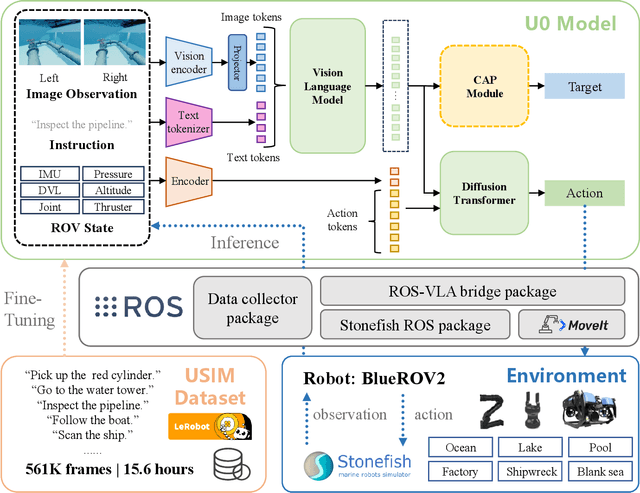
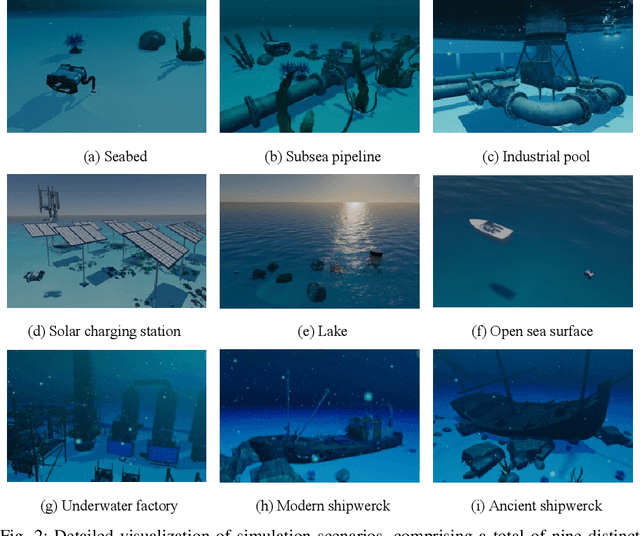
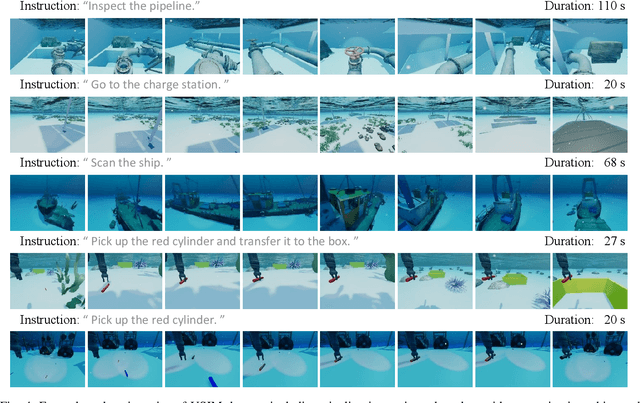
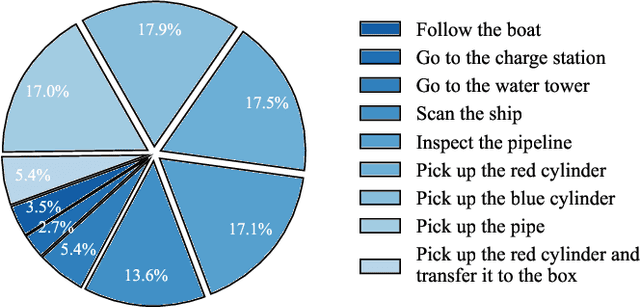
Underwater environments present unique challenges for robotic operation, including complex hydrodynamics, limited visibility, and constrained communication. Although data-driven approaches have advanced embodied intelligence in terrestrial robots and enabled task-specific autonomous underwater robots, developing underwater intelligence capable of autonomously performing multiple tasks remains highly challenging, as large-scale, high-quality underwater datasets are still scarce. To address these limitations, we introduce USIM, a simulation-based multi-task Vision-Language-Action (VLA) dataset for underwater robots. USIM comprises over 561K frames from 1,852 trajectories, totaling approximately 15.6 hours of BlueROV2 interactions across 20 tasks in 9 diverse scenarios, ranging from visual navigation to mobile manipulation. Building upon this dataset, we propose U0, a VLA model for general underwater robots, which integrates binocular vision and other sensor modalities through multimodal fusion, and further incorporates a convolution-attention-based perception focus enhancement module (CAP) to improve spatial understanding and mobile manipulation. Across tasks such as inspection, obstacle avoidance, scanning, and dynamic tracking, the framework achieves a success rate of 80%, while in challenging mobile manipulation tasks, it reduces the distance to the target by 21.2% compared with baseline methods, demonstrating its effectiveness. USIM and U0 show that VLA models can be effectively applied to underwater robotic applications, providing a foundation for scalable dataset construction, improved task autonomy, and the practical realization of intelligent general underwater robots.
LatticeWorld: A Multimodal Large Language Model-Empowered Framework for Interactive Complex World Generation
Sep 05, 2025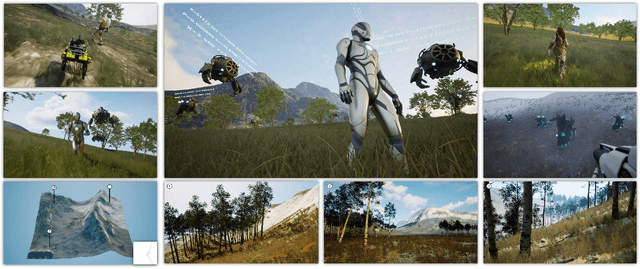
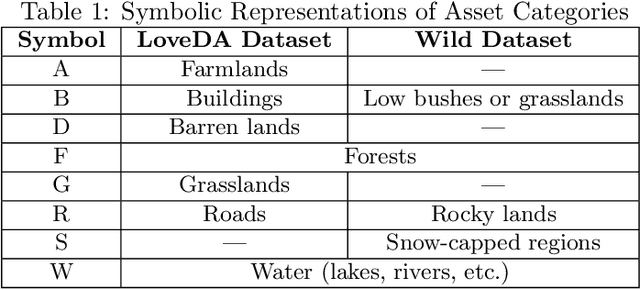
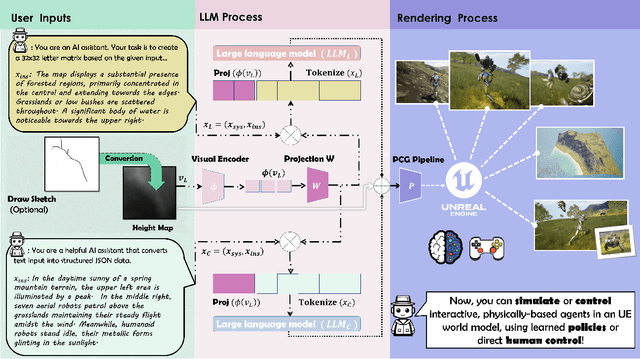
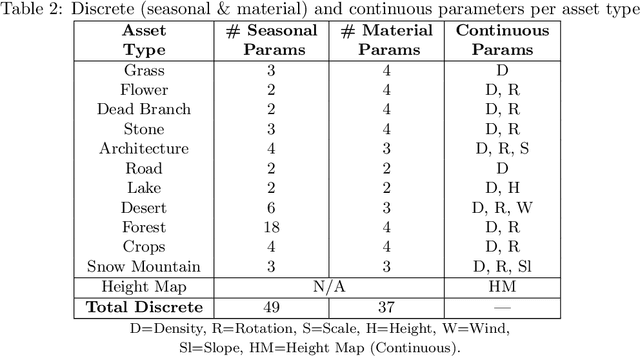
Recent research has been increasingly focusing on developing 3D world models that simulate complex real-world scenarios. World models have found broad applications across various domains, including embodied AI, autonomous driving, entertainment, etc. A more realistic simulation with accurate physics will effectively narrow the sim-to-real gap and allow us to gather rich information about the real world conveniently. While traditional manual modeling has enabled the creation of virtual 3D scenes, modern approaches have leveraged advanced machine learning algorithms for 3D world generation, with most recent advances focusing on generative methods that can create virtual worlds based on user instructions. This work explores such a research direction by proposing LatticeWorld, a simple yet effective 3D world generation framework that streamlines the industrial production pipeline of 3D environments. LatticeWorld leverages lightweight LLMs (LLaMA-2-7B) alongside the industry-grade rendering engine (e.g., Unreal Engine 5) to generate a dynamic environment. Our proposed framework accepts textual descriptions and visual instructions as multimodal inputs and creates large-scale 3D interactive worlds with dynamic agents, featuring competitive multi-agent interaction, high-fidelity physics simulation, and real-time rendering. We conduct comprehensive experiments to evaluate LatticeWorld, showing that it achieves superior accuracy in scene layout generation and visual fidelity. Moreover, LatticeWorld achieves over a $90\times$ increase in industrial production efficiency while maintaining high creative quality compared with traditional manual production methods. Our demo video is available at https://youtu.be/8VWZXpERR18
Segment Policy Optimization: Effective Segment-Level Credit Assignment in RL for Large Language Models
May 29, 2025Enhancing the reasoning capabilities of large language models effectively using reinforcement learning (RL) remains a crucial challenge. Existing approaches primarily adopt two contrasting advantage estimation granularities: Token-level methods (e.g., PPO) aim to provide the fine-grained advantage signals but suffer from inaccurate estimation due to difficulties in training an accurate critic model. On the other extreme, trajectory-level methods (e.g., GRPO) solely rely on a coarse-grained advantage signal from the final reward, leading to imprecise credit assignment. To address these limitations, we propose Segment Policy Optimization (SPO), a novel RL framework that leverages segment-level advantage estimation at an intermediate granularity, achieving a better balance by offering more precise credit assignment than trajectory-level methods and requiring fewer estimation points than token-level methods, enabling accurate advantage estimation based on Monte Carlo (MC) without a critic model. SPO features three components with novel strategies: (1) flexible segment partition; (2) accurate segment advantage estimation; and (3) policy optimization using segment advantages, including a novel probability-mask strategy. We further instantiate SPO for two specific scenarios: (1) SPO-chain for short chain-of-thought (CoT), featuring novel cutpoint-based partition and chain-based advantage estimation, achieving $6$-$12$ percentage point improvements in accuracy over PPO and GRPO on GSM8K. (2) SPO-tree for long CoT, featuring novel tree-based advantage estimation, which significantly reduces the cost of MC estimation, achieving $7$-$11$ percentage point improvements over GRPO on MATH500 under 2K and 4K context evaluation. We make our code publicly available at https://github.com/AIFrameResearch/SPO.